
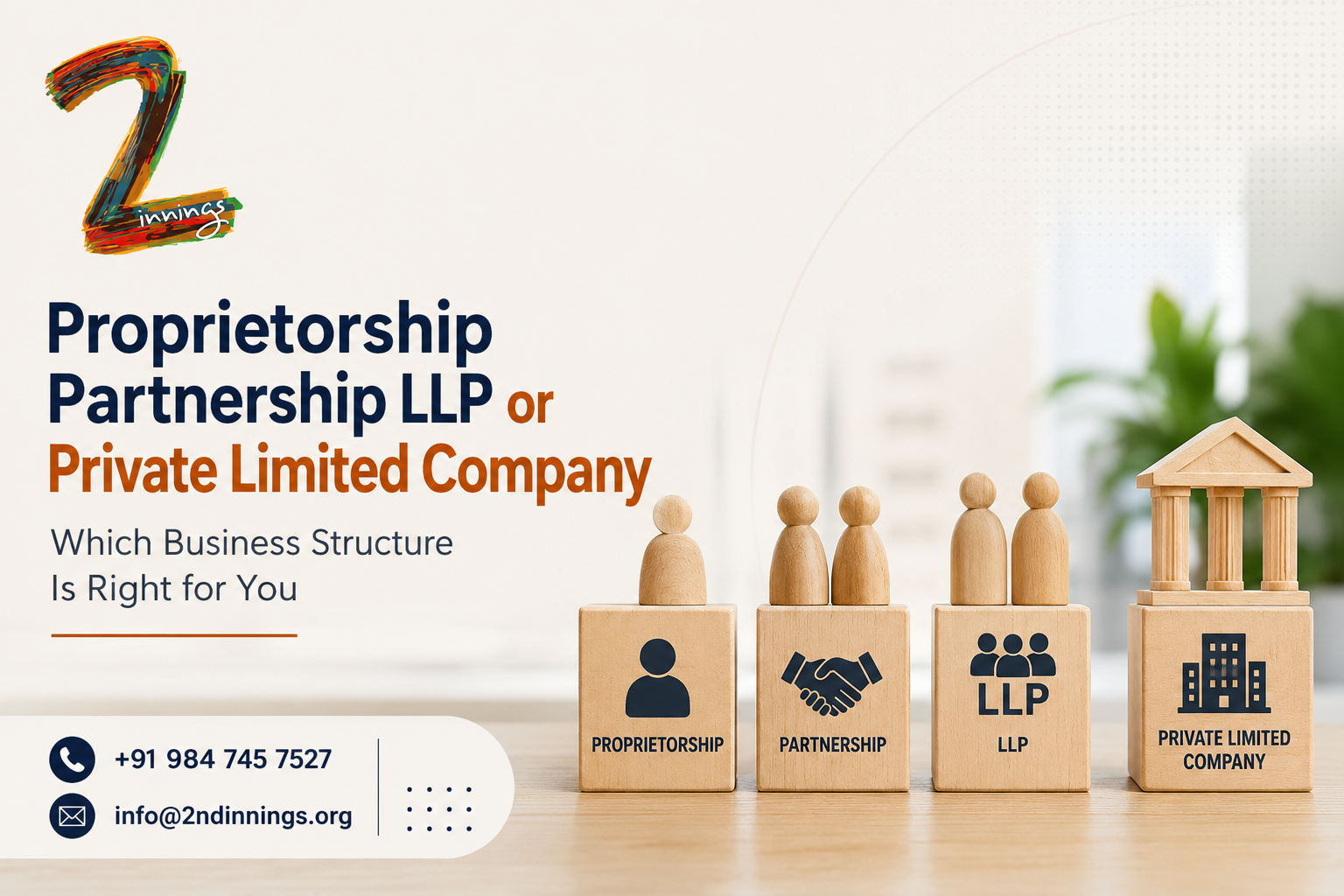
Proprietorship, Partnership, LLP or Private Limited Company – Which Business Structure is Right for You?
Starting a business involves more than choosing a name and offering a product or service. One of the first decisions an entrepreneur needs to make is selecting the right legal structure for the business.
In India, four common options are proprietorship, partnership, Limited Liability Partnership and private limited company. Each structure has different implications for ownership, liability, compliance, taxation, funding and future expansion.
There is no single structure that works for every business. The right choice depends on factors such as the number of owners, level of financial risk, expected growth, funding plans and the amount of compliance the business can manage.
Here is a practical comparison to help you understand the differences.
What Is a Proprietorship
A proprietorship is one of the simplest ways for an individual to operate a business. The business is owned and managed by one person, and there is no separate legal identity between the owner and the business.
This structure can be suitable for individuals running small businesses, independent professional services, local shops, home based businesses and other ventures where the owner wants direct control over operations.
The main advantage is simplicity. Decision making remains with the proprietor, and the business can generally be operated with fewer formalities than a company structure.
However, the owner also carries the business risk personally. If the business has financial obligations, the distinction between the owner’s personal assets and the business is not the same as it would be under a limited liability structure.
A proprietorship may therefore work well when the business is relatively small and the financial and operational risks are manageable.
What Is a Partnership
A partnership allows two or more individuals to operate a business together based on an agreed partnership arrangement.
The partners can contribute capital, skills, experience or other resources and share responsibilities according to their agreement.
A partnership can be useful when people want to start a business together without adopting a company structure. However, partners need to clearly establish their rights, responsibilities, profit sharing arrangements and decision making process.
One important consideration is liability. In a traditional partnership, the partners can have personal liability for the firm’s obligations. This makes the level of business risk an important factor when considering this structure.
A properly prepared partnership agreement can also help reduce disagreements by clearly defining how important business matters will be handled.
What Is an LLP
A Limited Liability Partnership combines features of a partnership arrangement with limited liability protection.
An LLP is a separate legal entity from its partners. The Ministry of Corporate Affairs states that an LLP has perpetual succession and that the liability of its partners is generally limited to their agreed contribution, subject to the provisions of the law.
An LLP requires at least two partners and has designated partner requirements under the LLP Act. The Ministry of Corporate Affairs also provides a formal incorporation process for registering an LLP.
This structure can be particularly relevant for professional firms, consulting businesses, service providers and businesses operated by partners who want limited liability without adopting the full corporate structure of a private limited company.
An LLP also provides flexibility in deciding how the partners will manage the business through the LLP agreement.
What Is a Private Limited Company
A private limited company is a separate legal entity incorporated under company law. It is often considered by entrepreneurs who want to build a business with plans for expansion, structured ownership and external investment.
A company structure can provide a more formal framework for ownership and management. Shares can be held by shareholders, while directors are responsible for managing the company according to applicable legal requirements.
This structure is commonly considered by startups and businesses that expect significant growth, want to bring in investors or intend to establish a more formal corporate structure.
The trade off is greater compliance. A private limited company has ongoing statutory requirements relating to accounts, filings, records and corporate governance.
Therefore, incorporation should not be based only on the perceived status of a company. The entrepreneur should consider whether the business actually needs its benefits and is prepared to maintain the required compliance.
Proprietorship vs Partnership vs LLP vs Private Limited Company
The basic differences can be understood through a few important factors.
Number of owners
A proprietorship has one owner.
A partnership has two or more partners.
An LLP requires at least two partners.
A private limited company has shareholders and directors within a formal corporate structure.
Liability
A proprietorship does not create the same separate legal identity between the owner and business that exists in an LLP or company.
Traditional partnership structures can expose partners to personal liability for business obligations.
An LLP provides separate legal identity and limited liability subject to applicable law.
A private limited company is also a separate legal entity, with shareholder liability generally limited according to the applicable corporate framework.
Control
A proprietor has direct control over the business.
In a partnership, decisions are shared between partners according to the partnership arrangement.
An LLP allows partners to define their internal management arrangements through an LLP agreement.
A private limited company has a more formal distinction between shareholders and directors.
Compliance
Proprietorship generally involves fewer formalities.
Partnership compliance depends on the applicable registration and tax requirements.
LLPs have statutory filing and accounting obligations.
Private limited companies generally have more extensive ongoing corporate compliance requirements.
The GST system itself recognises different business constitutions, including proprietorship concerns, partnership firms, companies and LLPs.
Which Structure Is Better for a Small Business
For a small business operated by one person, a proprietorship may be appropriate when simplicity and direct control are the main priorities.
For two or more people starting a business together, a partnership can be considered when the partners are comfortable with the structure and its liability implications.
An LLP can be a stronger option when multiple owners want a partnership based management style along with limited liability.
A private limited company may make more sense when the business has ambitious expansion plans, expects to raise investment or needs a formal corporate structure.
The size of the business alone should not determine the choice. The nature of the business and its future plans are equally important.
When Should You Consider Changing Your Business Structure
The structure chosen at the beginning does not necessarily have to remain unchanged forever.
A proprietor may later consider moving to a company structure when the business grows, takes on greater financial risk, requires external funding or needs a different ownership arrangement.
Similarly, business partners may consider an LLP when they want limited liability and a more formal legal structure.
A change may also become relevant when the business wants to bring new owners into the organisation or prepare for larger commercial opportunities.
Before making such a change, the entrepreneur should evaluate the legal, accounting, taxation and compliance implications.
Questions to Ask Before Choosing a Business Structure
- Before registering a business, consider these questions:
- How many people will own the business?
- How much capital will be invested?
- What level of financial risk does the business carry?
- Will the business require external funding?
- Do you expect to add investors or new owners later?
- How much control does each owner want?
- Are you comfortable with ongoing compliance requirements?
- Could the business expand significantly in the coming years?
- Answering these questions can make the decision much clearer.
There Is No Universal Best Business Structure
Choosing between proprietorship, partnership, LLP and private limited company is ultimately a business decision rather than a question of which structure sounds more established.
A small individual business may benefit from a simple structure. A professional firm with multiple partners may find an LLP more suitable. A growing venture with plans for investment and expansion may consider a private limited company.
The important thing is to choose a structure that matches the present needs of the business while keeping future plans in mind.
At 2nd Innings, entrepreneurs can seek professional assistance with business registration, accounting, taxation and related compliance requirements. The right guidance at the beginning can help avoid structural and compliance problems as the business grows.
Note: Business registration, taxation and compliance requirements can vary according to the nature and circumstances of the business. Professional advice should be obtained before selecting or changing a business structure.

All Categories
Recent Posts
5 Costly Accounting Mistakes Business Owners Often Overlook