
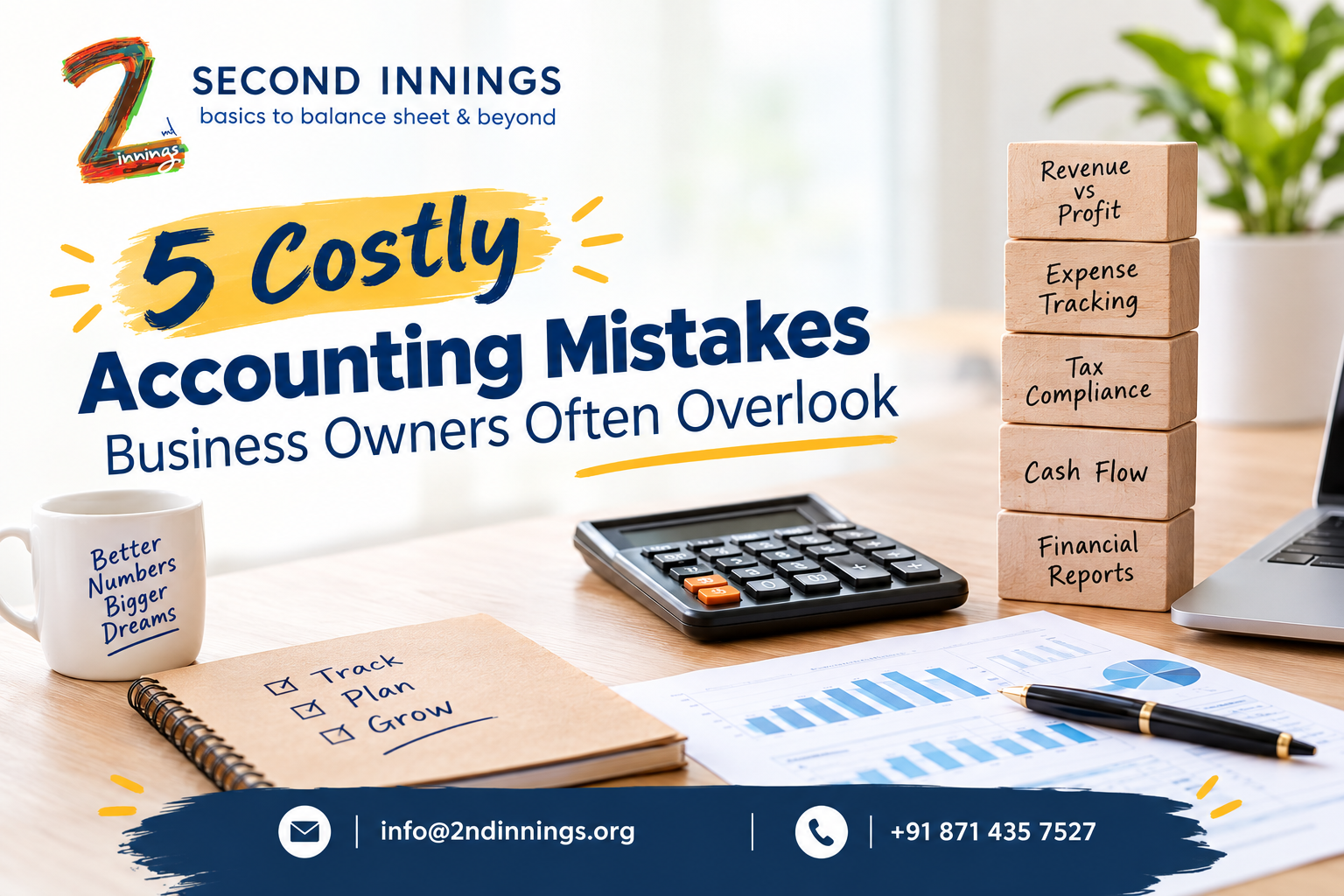
5 Costly Accounting Mistakes Business Owners Often Overlook
A business does not always lose money because of poor sales or high expenses.
Sometimes, the problem starts with something that appears much smaller — a missed invoice, an incorrect expense entry, delayed bookkeeping, or weak financial controls.
These may look like routine accounting issues, but over time they can affect cash flow, tax calculations, financial reporting and, more importantly, business decisions.
Here are five accounting mistakes that business owners often overlook.
- Mixing Business and Personal Expenses
One of the most common mistakes is using business funds for personal expenses, or personal accounts for business transactions.
When business and personal transactions are mixed, it becomes difficult to understand the actual financial position of the business.
It can also make bookkeeping, bank reconciliation, tax calculations and financial review more complicated than they need to be.
A simple discipline can prevent much of this:
- Maintain a separate bank account for the business.
- Use the business account for business transactions.
- Record personal withdrawals properly.
- Keep supporting documents for business expenses.
- Reconcile the bank account regularly.
Business money should not become your personal wallet.
Keeping the two separate gives the business owner a much clearer picture of how the business is actually performing.
- Delaying Bookkeeping
Many businesses postpone bookkeeping until the end of the month, quarter or even the financial year.
The problem is that delayed bookkeeping also means delayed information.
Invoices may not be followed up on time. Expenses may be missed. Payments may not be properly recorded. Outstanding receivables and payables may not be visible. Cash flow problems may therefore remain unnoticed until they become serious.
Regular bookkeeping should capture both sides of the business — not just sales.
This includes:
- Sales and other income
- Receipts and collections
- Purchases and expenses
- Payments
- Receivables and payables
- Loans and repayments
- Fixed assets
- Inventory, where applicable
- Bank and cash transactions
The objective of bookkeeping is not simply to prepare accounts at year-end.
Your books should tell you what happened last month while there is still time to do something about it.
- Failing to Track Outstanding Invoices
A business can show healthy sales on paper and still struggle with cash flow.
Why?
Because a sale is not the same as a collection.
A sale is good news. A collection is better news.
If outstanding invoices are not monitored properly, money that belongs to the business can remain stuck with customers for weeks or months.
A simple receivables report should help the business owner know:
- Who owes the money?
- Which invoice is outstanding?
- When was the invoice raised?
- What were the agreed payment terms?
- How much is overdue?
- How long has it been outstanding?
- Who is responsible for following up?
It is not enough to know that total receivables are ₹20 lakh.
The more important question is: Where is that ₹20 lakh, and how long has it been there?
Regular receivables review can improve collections and help the business plan its cash requirements better.
- Not Reviewing Financial Statements Regularly
Financial statements contain valuable information about the health of a business.
But preparing them is only the first step.
Business owners should also spend some time understanding what the numbers are saying.
For example:
- Are expenses increasing faster than sales?
- Are margins declining?
- Are receivables increasing?
- Is cash flow becoming tighter?
- Are there unusual or unexpected transactions?
- Are some products or services becoming less profitable?
The business owner does not have to become an accountant.
But the owner should understand the key numbers that affect the business.
Accounts should not merely tell you what happened.
They should help you understand what is happening and where attention may be required.
- Relying on Weak Financial Controls
Good accounting is not only about recording transactions correctly.
It is also about having simple systems that reduce the possibility of errors, unnecessary spending and unauthorised transactions.
Even a small business can have basic controls such as:
- Clear approval procedures
- Proper supporting documents
- Regular bank reconciliation
- Periodic review of receivables and payables
- Review of unusual or large transactions
- Proper access controls
- Regular checking of ledgers and outstanding balances
These controls do not have to be complicated.
The objective is simply to ensure that money is spent properly, transactions are recorded correctly and the business owner has confidence in the numbers.
The Real Cost of an Accounting Mistake
An accounting mistake may begin with a small entry.
But its impact may go much further.
A missed invoice can affect collections.
An incorrect expense can affect profitability.
Delayed bookkeeping can hide a cash flow problem.
Poor records can complicate tax compliance.
Weak controls can result in unnecessary or unauthorised expenditure.
And when the numbers are not reliable, the business owner may make decisions based on an incorrect picture of the business.
That is why good accounting is not merely about maintaining records.
It is about creating reliable information that helps the owner decide when to spend, when to hire, when to expand, when to be cautious and how to plan for the future.
Your Accountant Should Not Enter the Picture Only at Year-End
For many business owners, accounting becomes important mainly when tax returns, audits or statutory requirements are due.
But accounting can be much more useful than that.
A properly maintained backend accounting function can give the business regular visibility over its transactions, collections, payments, outstanding balances and financial performance.
Depending on the size and needs of the business, this may mean having an internal accounts team, getting backend accounting support, or having an external professional supervise and review the accounting function.
At 2ndinnings, we support businesses with backend accounting and financial processes including bookkeeping, receipts and payments, bank reconciliation, ledger review, receivables and payables, documentation and financial reporting.
The objective is simple — to help business owners have reliable numbers and better visibility, without making accounting more complicated than it needs to be.
Good business decisions need good numbers. And good numbers begin with good accounting.

All Categories
Recent Posts
5 Costly Accounting Mistakes Business Owners Often Overlook